
Inside this article
- Optimus & robotaxi catalysts
- The earnings expectations
- Expected moves & key levels
Q3 2026 preview · October 21, 2026
Welcome to Tesla earnings day! Tesla (TSLA) reports Q3 2026 results after the close today, Wednesday, October 21, with the call at 2:30 p.m. Pacific / 5:30 p.m. Eastern. Tesla’s earnings announcement confirms the schedule.
My take: Tesla is an AI company that happens to sell cars. The auto business still matters, but Optimus and robotaxi are the catalysts I’m watching for a potential change in the stock’s character.
After several failed breakouts and a rough reaction to last quarter’s report, I want to know whether tonight brings enough evidence to get Tesla moving again. Here’s the business story, the earnings bar, and the options levels on my screen.
Why I see Tesla as an AI company that sells cars
Wall Street grades Tesla on deliveries and car margins. My longer-term thesis centers on what Tesla can build with its driving software, manufacturing capacity, computing infrastructure, and robotics work.
Those are different questions. A delivery beat can help the quarter without proving the AI thesis. An encouraging robot demonstration can strengthen the story without generating meaningful revenue yet.
There is real infrastructure behind that story. In its Q2 update, Tesla reported more than 205 MW of combined Cortex 1 and Cortex 2 AI training capacity and FSD subscriptions attached to more than 55% of new North American deliveries. It also described new Grok features inside its vehicles. Source: Tesla’s Q2 update.
More recently, Tesla’s shareholder materials described more than 15 billion cumulative FSD miles and nearly 1.5 million paid customers. Those are company-reported figures; FSD (Supervised) still requires active driver supervision. Source: Tesla’s October shareholder materials.
That is why I’m watching the AI story so closely. It is also why I want measurable progress, not just another ambitious timeline.
What about cars and margins?
Cars are still doing most of the revenue work. Automotive revenue was about 73% of Tesla’s Q2 total, while operating margin was just 1.4%. That makes the cost of building the next chapter a central part of this earnings report. Source: Tesla’s Q2 financial summary.
The Q3 delivery number is already out: 486,532 vehicles, versus the 461,974 average in Tesla’s company-compiled analyst survey. Energy storage deployments were 13.7 GWh, below that survey’s 15.9 GWh average. Deliveries alone do not tell us the quarter’s profitability. Tesla’s production report, delivery consensus.
Tonight, I want to see whether those deliveries translated into stronger margins and cash flow—and how much investment the AI and robotics plans require from here.
Optimus: the catalyst needs a production milestone
Optimus is one of the biggest reasons I think Tesla deserves to be analyzed beyond its car business. But there is a difference between a large addressable market and a business that is ready to scale.
Tesla said it had decommissioned the Model S and Model X lines at Fremont and was installing its first Optimus production lines, with initial builds intended for training and development. It also reported construction progress in Texas. Source: Tesla’s Q2 manufacturing update.
My timeline for evaluating progress is straightforward:
- Near term: Has Fremont started producing robots, and at what actual rate?
- Next stage: What can those robots reliably do outside a demonstration, and what does the next version improve?
- Commercial milestone: When does an outside customer pay for useful work, and what are the economics?
I’m interested in the upside. I also want management to separate production targets from production achieved. Timelines have slipped before; the evidence matters more than the headline.
Robotaxi: the AI proof point is on the street
Robotaxi is the other part of the story I’m watching closely. Tesla’s Q2 materials listed operations in Austin, Dallas, Houston, Miami, Orlando, Tampa, and the San Francisco Bay Area. The Bay Area service used a safety driver, so those seven markets should not all be described as equivalent driverless deployments. Source: Tesla’s services update.
My questions for tonight: How many paid rides are being completed? How quickly is Cybercab production ramping? Which new markets have firm launch dates? And what does it cost to operate the service?
Tesla’s ability to manufacture its own vehicles is part of my thesis. Scaling still requires reliable operations, customer demand, and regulatory progress.
That last point matters: NHTSA opened an inquiry into Cybercab’s compliance with federal vehicle safety standards in September. I’ll be listening for a substantive update. Source: NHTSA’s announcement.
The setup: a stock that needs to prove it can hold a breakout
The repeated failures around the $400–$420 zone are why this report has my attention. I like the possibility of an AI catalyst meeting a stock that has struggled to sustain upside. That is a setup to watch, not proof that the reaction will be positive.
For context, my October 20 thinkorswim chart marks a prior high of $498.83. The stock still has substantial ground to cover before it challenges that level.
For the earnings bar, Tesla’s October 19 company-compiled consensus shows $0.45 in non-GAAP EPS, $0.23 in GAAP EPS, and $28.34 billion in revenue. Those are analyst estimates, not results or Tesla guidance. Keeping GAAP and adjusted earnings separate matters when comparing the headline after the close. Source: Tesla’s Q3 earnings consensus.
My pre-earnings options map
My October 20, 2026 thinkorswim chart shows a $22.80 Market Maker Move with a $374.74 displayed stock price. That is approximately 6.1% of the chart’s reference price.
Using the move amounts displayed on that chart, here are the levels around that reference price:
- 1× move ($22.80): approximately $351.94–$397.54.
- 1.5× move ($34.20): approximately $340.54–$408.94.
- 2× move ($45.61): approximately $329.13–$420.35.
Source: Danielle Shay’s Earnings Hot Zone chart in thinkorswim, captured October 20. These are dated chart-reference levels, not a live quote or a guaranteed trading range. The screenshot does not identify a specific options expiration; these levels should not be treated as an expiration-specific options-chain quote.
Against that snapshot, $400 sits just beyond the upside 1× level, while $420 is near the upside 2× level. A close above $420 that holds is still the breakout confirmation I’m watching. A positive headline without follow-through would leave the same question unresolved.
On the downside, the chart’s lower 1× reference is near $352. Price and options pricing can change before the report, so I’ll reassess the setup against the market rather than treating yesterday’s levels as fixed targets.
What my Earnings Hot Zone chart adds
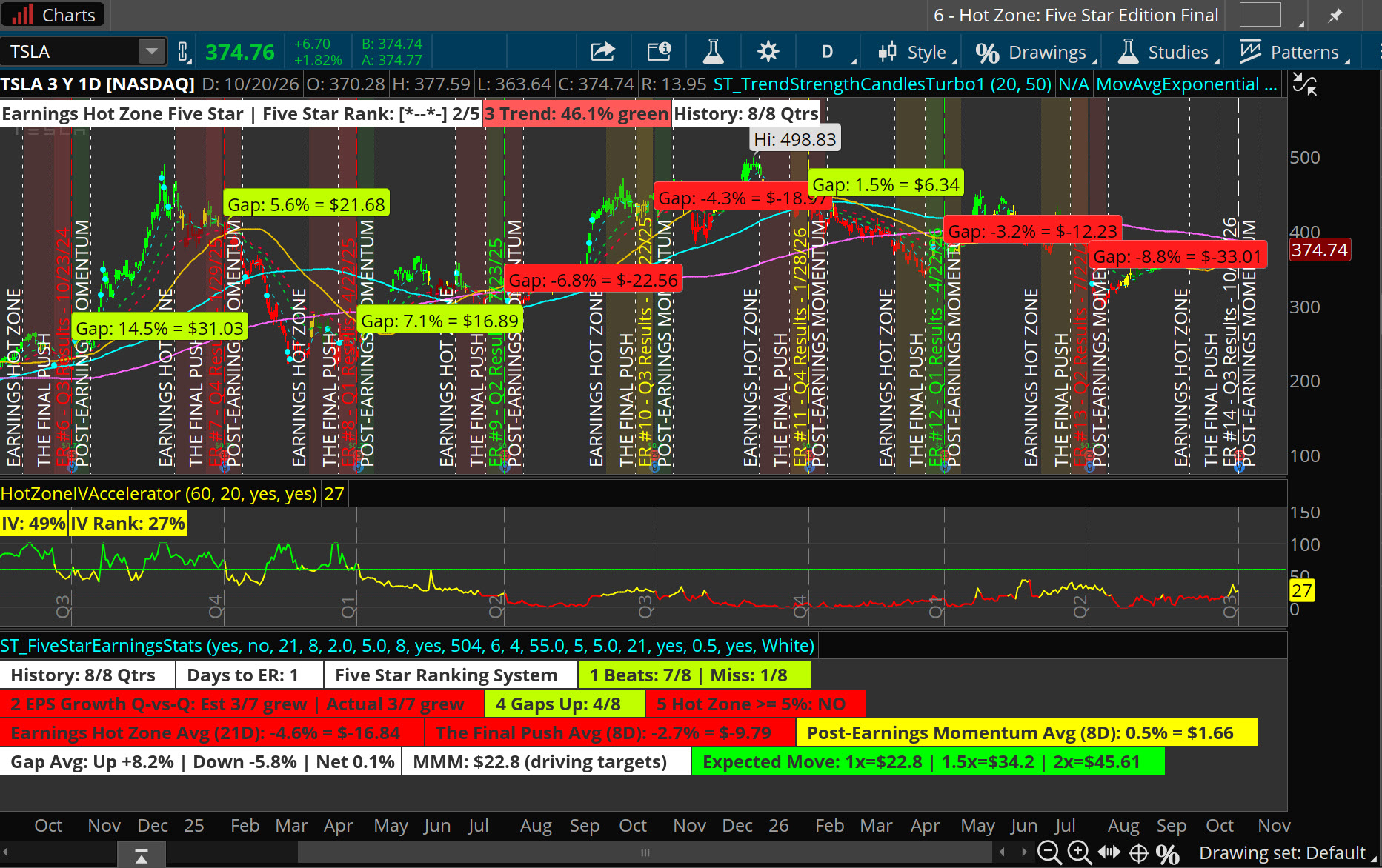
Chart: Danielle Shay / thinkorswim, October 20, 2026. Click or open the image to inspect the original chart.
My chart gives this setup some needed context:
- The last four displayed earnings gaps: −4.3%, +1.5%, −3.2%, and −8.8%.
- The last large upside gap shown: +14.5% in October 2024.
- Eight-quarter history: four gaps up out of eight, with average eight-day post-earnings momentum of approximately +0.5%.
- Five Star rank: 2 out of 5. This is not a strong historical ranking just because I like the longer-term AI thesis.
The price map above uses this chart’s own displayed move amounts. The chart and historical reactions are dated October 20; the earnings event is October 21.
The lesson from this history: an earnings beat and a good stock reaction are separate things. I want to see price confirm the story.
What I’m watching on tonight’s call
- Robotaxi: Paid rides, fleet utilization, Cybercab production, and specific expansion dates.
- Optimus: Fremont output, the next version’s capabilities, and evidence of a commercial customer.
- Cars and energy: Automotive margins, storage profitability, and cash flow after the delivery beat.
- Investment: The spending required to turn the AI roadmap into operating businesses.
- Regulation: Progress on Cybercab’s compliance questions and the conditions for broader deployment.
My thesis is that Tesla’s next major chapter is about AI, autonomy, and robots. Tonight, I want evidence that the business is moving toward that chapter—and a chart that starts to confirm it.
Get my Earnings Watchlist
Tesla is one of the names on my watchlist this week. Use the Options Earnings Calendar to compare expected moves and upcoming reports, and get The Earnings Watchlist for my weekly research.
For the broader setup, read this week’s Earnings Watchlist. If you’re holding options through a report, review how IV crush works alongside your directional thesis.
Onwards and upwards,
Danielle
Disclosure: Danielle Shay owns shares of Tesla (TSLA). This article is educational commentary, not a personalized investment recommendation. Options involve risk, and historical earnings reactions do not guarantee future results.